Africa speaks two thousand languages. Its digital world speaks five.
Africa’s digital divide has long been measured in coverage rates and gigabyte prices. The next one will be measured in languages.
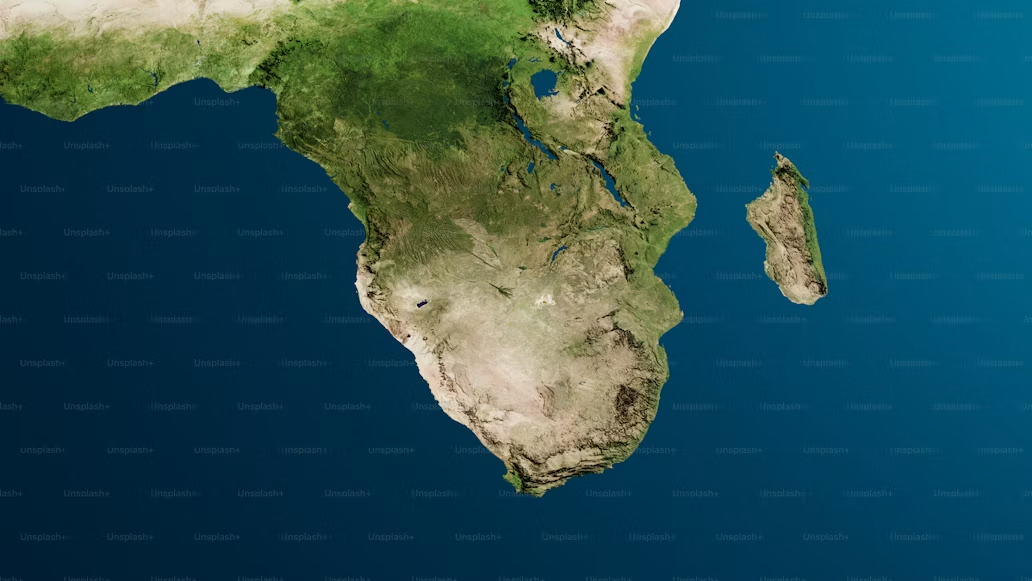
I grew up in Brazzaville, where you switch from Lingala to Kituba to French in the same sentence without thinking. I live in Algiers, where you switch from Darija to Modern Standard Arabic to Tamazight to French with the same ease. Between the two, four thousand seven hundred kilometres and not a single language shared on the street.
This experience is nothing exceptional — it is the ordinary condition of hundreds of millions of Africans. What is remarkable is that none of the digital tools I use daily in these two cities takes it into account.
The imbalance, in one sentence
The continent has roughly two thousand languages, nearly a third of the world's living languages. Nigeria alone has more than five hundred.
A handful of them have a serious digital existence — reliable translation tools, speech recognition, spellcheckers, abundant content, presence in language models. Arabic, Afrikaans, Swahili, Amharic, Hausa and a few others. All the rest, including languages spoken by tens of millions of people, exist digitally as a trace.
Lingala is spoken by several tens of millions of speakers in the Congo Basin. Try dictating a message in that language on your phone. Try obtaining a reliable translation of an administrative document. Try finding a medicine information leaflet.
The self-reinforcing loop
The mechanism is simple, and that is what makes it formidable.
Automatic language processing systems learn from corpora. The corpora come overwhelmingly from the web. The web reflects what is written online. But most African languages are primarily oral, or written in contexts — family, oral, radio — that leave no indexable textual trace.
Few available texts produce mediocre models. Mediocre models produce unusable tools. Unusable tools give nobody a reason to write in that language online. Which produces few available texts.
The loop closes on itself, and each passing year widens the gap with well-resourced languages, whose corpora grow while the others stagnate. This is not a stable inequality; it is an inequality that worsens mechanically.
African researchers understood this before everyone else. The Masakhane community, born on the continent, has been working for several years to build corpora, evaluation sets and models for African languages, with resources far outmatched by those of the big laboratories. It is remarkable work that is structurally underfunded.
What this costs, concretely
This topic is often discussed in heritage terms — preserving, celebrating, transmitting. These words are fair but they weaken the argument, because they place the question in the culture section, where it belongs in the access-to-rights section.
In health, a prevention campaign broadcast in a language the target population does not master is a campaign that did not happen. During health crises, vital information circulates on the radio in local languages, while official portals remain monolingual.
In public services, digitisation is advancing fast on the continent — civil records, taxes, diplomas, identity. Almost always in the inherited official language. For a citizen who speaks it poorly, dematerialisation does not remove the counter: it replaces it with a wall, and a paid intermediary.
In financial services, inclusion relies on interfaces. A user who does not fully understand the screen they are validating does not become an autonomous customer; they become a dependent customer, and vulnerable to fraud.
In agriculture, weather advice, phytosanitary guidance and market price information arrive by SMS or app, in French or English, to producers who think, count and negotiate in another language.
Every time, the same pattern: the service exists, the infrastructure exists, the phone exists — and the usage does not happen.
Oral as a bypass route
There is a reason to be optimistic, and it is underexploited.
If text is the format that penalises African languages, voice is the one that could restore them. An oral language remains a fully functional language: it has vocabulary, grammar, speakers. What it lacks is a digital channel suited to its nature.
Voice interfaces offer that channel. They would allow access to an administrative service, health information or a bank account without passing through writing, and therefore without passing through literacy in a foreign language.
The obstacle is known: speech recognition requires even more annotated data than text, and for many African languages that data does not exist. But there is a considerable resource that nobody has thought to mobilise seriously: the archives of African radios. Decades of broadcasts, in dozens of languages, with native speakers, in suitable recording conditions.
I work in a radio station that broadcasts in five languages. I know what these archives represent. They are, literally, the corpora that are missing — sleeping on servers, without annotation, without a legal framework for reuse, with nobody connecting the broadcasters to the researchers.
There is a pan-African project to build here, and it would cost a fraction of what a data centre costs.
The right way to frame the problem
As long as the language question is treated as a cultural topic, it will be funded as a cultural topic — that is, poorly.
It must be framed differently. A business that cannot address its customers in the language they think in loses customers. A state that cannot address its citizens in the language they live in produces administrative exclusion, and therefore mistrust. An institution that organises a summit without mastering its language chain loses in decision quality.
Language is not a cultural supplement to African digital life. It is its access layer.
We spent twenty years building cables, antennas and networks to connect the continent. That was necessary, and it largely succeeded. But one can be perfectly connected and remain outside, if everything that circulates on the network is written in a language one does not speak.
The next African digital divide will not be an access divide. It has already begun, and it is a language divide.