Education in Africa: learning differently to prepare for the future
On The African Pulse, on Ifrikya FM, Imen Nouad and Moïse Selph spent half an hour on education in Africa and the future of learning. Can digital education democratise knowledge while the digital divide runs so deep? What is a degree worth when it does not match what employers actually need? And what should the continent’s young people learn so that they build, rather than wait?
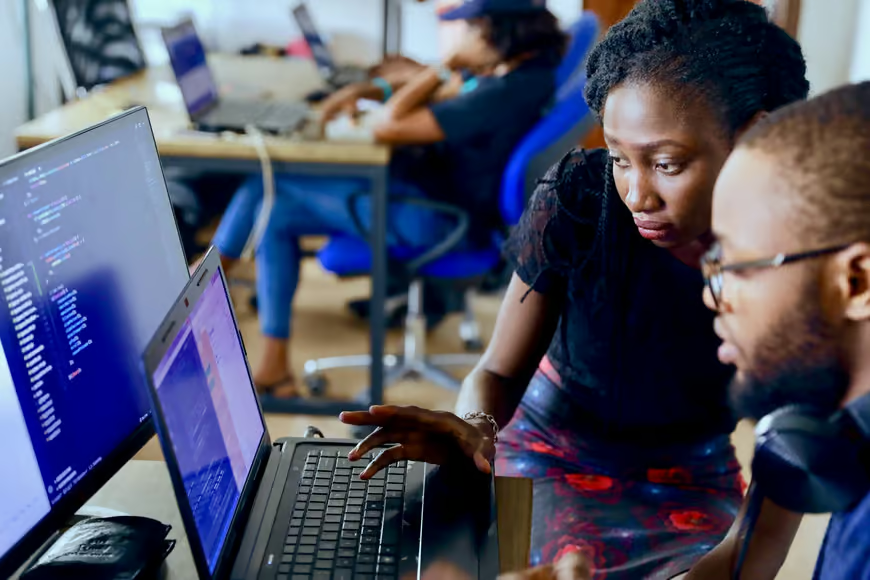
On 14 September 2026, The African Pulse, the English-language programme of Radio Ifrikya FM hosted by Imen Nouad, devoted a half-hour edition to education in Africa and the future of learning. This text is not a transcript of it. It takes up its ideas, in the order in which they followed one another, so that they can be read without listening and discussed afterwards.
Two perspectives complement each other there more than they oppose each other. Moïse addresses the digital transition, scientific fields of study and entrepreneurship among young people. Imen brings the discussion back each time to material conditions: access, cost, teacher training, and what the labour market really expects of graduates.
African education facing a paradigm shift
The debate opens on a shared observation: the African education system faces major challenges. Moïse stresses the urgency of modernising teaching methods, and he places that urgency in time. The continent is going through two transitions at once, one demographic, the other digital, and school as it works today was designed to accompany neither. A generation larger than the previous one is arriving in classrooms that still teach as they used to, for a world that is no longer as it was.
Imen shares this observation and broadens its scope. The problem is not only the method, it is the map: regional disparities are deep, and she insists on the need to rethink access to teaching resources, in particular for young people in rural or disadvantaged areas, those for whom modernisation remains just a word as long as it does not reach them. The framework is set: change the way people learn, yes, but on condition of reaching the least well-served pupils.
Can digital technology democratise access to knowledge?
Moïse then sets out what digital technology changes, or can change, in the classroom. He mentions two levers: interactive educational platforms and access to distance courses. The value he sees in them is not primarily technical. These tools make possible what geography used to rule out: following a quality course without living near the institution that teaches it. It is in this sense that he speaks of democratising knowledge.
The argument answers precisely the disparities described earlier. If the obstacle is the distance between the pupil and the resource, then a resource that travels to the pupil is an answer. A distance course, a platform that can be reached from a phone, a library that no longer depends on a building: so many ways of getting around what, for decades, reserved the best training for those who lived in the right place. It remains to be seen how far this resource really travels, and at what cost.
Technology is not enough
Imen tempers the enthusiasm for technology without rejecting it, setting against it three very concrete obstacles. The first is network coverage, insufficient across a large part of the territories where pupils would most need these platforms. The second is the cost of computer equipment: a distance course requires a device to follow it, and that device has a price many families cannot pay. The third is human, and it is perhaps the one most often forgotten: teachers must be trained continuously in the new tools, otherwise technology arrives in the classroom with no one to use it.
These three points sketch what is called the digital divide, but they make it more precise than the expression usually does. The divide is not only between those who have a connection and those who do not. It also runs between the institutions that can equip their pupils and those that cannot, and between the teachers who have been supported and those who have been left alone in front of the tool.
Moïse describes what the platform makes possible at the end of the road; Imen, everything that is needed at the start for that end to exist. Digital education is a lever, but a lever needs a fulcrum, and that fulcrum is called infrastructure, equipment and training.
Training for which jobs?
The debate then leaves the classroom to look at what awaits pupils when they leave. Imen emphasises a frequent mismatch between traditional university curricula and the real needs of businesses. Young people graduate from courses that do not match what businesses are really looking for: the degree exists, the expected skill is not in it.
Her answer comes down to three directions: strengthen technical streams, develop vocational apprenticeships, and give priority to skills that can be put to direct use in the world of work. It is not a plea against the university, it is a plea for training to look at the market it claims to serve. The consequence, which the exchange does not spell out but which its argument implies, is that vocational training that teaches people to do what businesses are really looking for is worth more, to the person who takes it, than a prestigious path that leads nowhere.
Until then, the question was how to bring knowledge to pupils; here it becomes: which knowledge, and to do what. An education can be accessible and modern, and still be ill-suited if it prepares for a world of work that does not exist.
STEM, practical skills and entrepreneurship
Moïse approaches the same question from another side. He argues for promoting STEM fields in Africa, that is, science, technology, engineering and mathematics, as well as developing entrepreneurship among young people. Read together, the two answer each other: the scientific disciplines provide the tools, entrepreneurship provides a reason to use them that does not depend on an employer.
For that is where his central idea lies. The future of learning in Africa, he maintains, must also go through young people’s ability to create local solutions, suited to the economic, social and technological realities of the continent. In other words, school must not only prepare people to hold a job; it must prepare them to invent jobs, and to invent the products and services that the African context calls for and that no one will come and design in their place.
Placed side by side, Imen’s and Moïse’s positions do not make two programmes, but a single one, read from two sides. She describes what the labour market demands today and what school does not provide. He describes what young people could build tomorrow if they were given the means. Professional skills on one side, the capacity to create on the other: an education that gives only the first produces people who carry out tasks for businesses that do not yet exist; an education that gives only the second produces entrepreneurs without a trade.
Building tomorrow’s African school
Moïse and Imen conclude on the same need: better synergy among all those who make education. None of the five actors they name can, alone, produce the education the continent needs. Each one’s share can be read this way: public policies set the framework and fund the network without which the platforms and equipment brought by private initiatives reach no one; institutions train, provided their teachers are trained themselves; businesses say which skills they need and open their doors to apprenticeships; and actors on the ground know where the pupils are whom the statistics do not see.
The goal the two speakers set out at the end of the exchange comes down to four adjectives, and each answers a moment in the debate. A resilient education, because the demographic and digital transitions will not stop to let school reorganise itself. Inclusive, because the digital divide and regional disparities exclude first those who have the least. Accessible, because knowledge that does not travel to the pupil is not democratised knowledge. Geared towards innovation, because training young people to reproduce is no longer enough when the world they are joining changes faster than the curricula.
What emerges from this half-hour is not a solution, it is a way of ordering the problem. Education in Africa will not change because someone has decided it must change, but because those who fund it, those who deliver it and those who hire at its end will have agreed to pull in the same direction.
Keep reading
- See alsoThe price of entryStarting a company has always meant buying skills you lack, which means raising capital before you know whether the idea holds up. Seven chapters on how artificial intelligence changes that equation — and why a founder with no capital can welcome it without being naive about what it threatens.Series · 7 chapters · 38 min readon access to skills and founding without capital
- Go deeperThe shrinking listI published a piece that contradicted itself: it argued for assessing what machines cannot do, and reported the objection that dismantles it. Seven parts to settle that debt.Series · 7 episodes · 52 min read
- ExtendLeaving at fourA chief financial officer told me he was going to pick up his daughter from school for the first time in six years, and that he owed it to a machine. I found the story beautiful. Then I looked at who in his department had disappeared so that this hour could exist. Seven episodes.Series · 7 episodes · 45 min read


Related Africa Tech episodes
Host of Africa Tech, Nzamba and Umuzi on Ifrikya FM, Algeria's pan-African radio station. Founder of Lobaka, co-founder of Sunnubang, creator and author of BAKOKO.
Follow the analyses by RSS (in French)